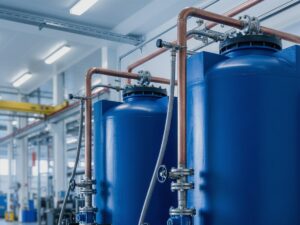



As durability, corrosion resistance, and operational cost optimization become increasingly crucial, the choice of materials for filter tanks, storage vessels, and pressure tanks has become a key factor determining the long-term performance of water treatment systems. Fiberglass Reinforced Plastic (FRP) composite is emerging as a comprehensive solution — ultra-durable, corrosion-resistant, lightweight, and highly customizable, suitable for a wide range of industrial applications from food and pharmaceutical manufacturing to municipal water and wastewater treatment.
What is Composite FRP? Composition & Classification
Definition and Basic Structure
FRP (Fiberglass Reinforced Plastic) is a composite material consisting of reinforcing fibers (commonly glass fibers) embedded in a resin matrix such as polyester, vinyl ester, or epoxy. The fibers provide tensile strength and mechanical reinforcement. The resin matrix binds the fibers, transfers loads, and protects them from environmental and chemical damage.
Common Types of FRP in Water Treatment Applications
- GRP/FRP (Glass Reinforced Plastic): The most widely used type, offering an excellent balance between cost and performance — ideal for filter tanks and storage vessels.
- Vinyl Ester Reinforced FRP: Preferred when superior chemical and corrosion resistance is required compared to polyester-based FRP.
- Carbon-FRP: Extremely strong and rigid but more costly — less common in water filtration applications due to its high price and over-spec mechanical properties.
Layer Structure and Fiber Orientation
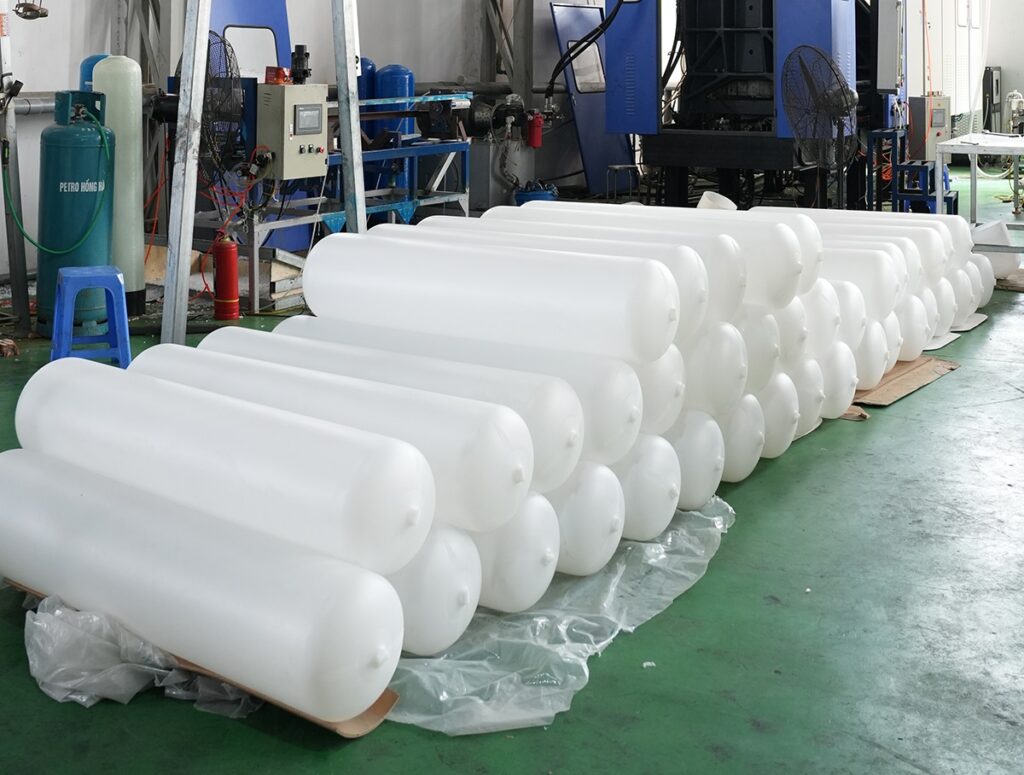
FRP components are typically designed with multiple fiber layers, arranged in different orientations (hoop, longitudinal, cross) to balance stresses and increase hoop strength (circumferential pressure resistance) as well as axial strength. The fiber orientation and resin-to-fiber ratio largely determine the final mechanical properties and durability of the product.
Key Advantages of FRP Tanks and Vessels in Water Treatment
Exceptional Chemical and Corrosion Resistance
One of FRP’s greatest strengths is its superior resistance to corrosion caused by saline water, chlorine, mild oxidants, and many treatment chemicals. Compared with steel, FRP eliminates rust and leakage risks, significantly reducing maintenance and replacement costs over time.
High Strength-to-Weight Ratio — Easy Handling & Installation
FRP is significantly lighter than metals while maintaining strong structural integrity. This simplifies transportation, reduces the need for lifting equipment, and enables faster installation, even in confined or elevated locations.
Long Service Life & Low Operating Cost
Since FRP requires no anti-corrosion coating and minimal ongoing repairs, it provides a low life-cycle cost (LCC) and superior return on investment — especially in corrosive environments.

Fully Customizable Design and Fabrication
FRP tanks, pressure vessels, and filter housings can be custom-manufactured in various shapes, dimensions, and pressure ratings. This makes FRP ideal for tailor-made water systems where standard sizes or configurations are not suitable.
High Pressure Resistance with Advanced Fabrication Technology
With advanced filament winding and fiber alignment control, FRP tanks can be engineered to withstand significant internal pressure, making them perfect for high-pressure filtration systems such as RO and UF.
FRP Manufacturing Process for Filter and Pressure Vessels (Technical Overview)
Main Production Methods
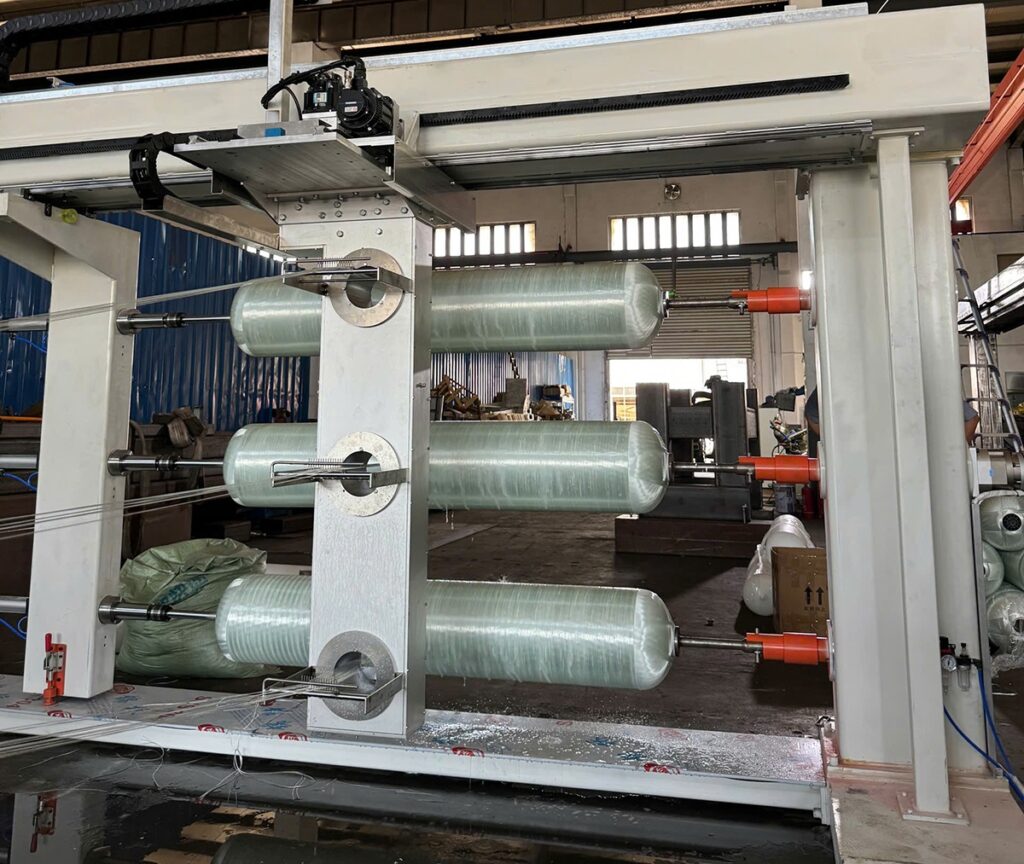
- Filament Winding: Continuous fiber winding over a mandrel — ideal for pressure vessels and cylindrical tanks, ensuring consistent fiber orientation and strength.
- Hand Lay-up & Spray-up: Cost-effective methods for large, non-pressurized structures such as storage tanks.
- Resin Transfer Molding (RTM): Closed-mold process providing excellent surface finish, dimensional accuracy, and precise resin control — suitable for aesthetic or high-spec components.
- Pultrusion: Continuous production of linear profiles (beams, tubes, rods) used for support and structural components.
Quality Control and Pressure Testing
A standard FRP manufacturing process includes:
- Layer thickness inspection
- Fiber/resin bonding verification
- Hydrostatic pressure testing
- Wall thickness and surface defect inspection
- Chemical resistance testing
Each production batch must have comprehensive quality documentation to ensure compliance with design and performance specifications.
Applicable Standards and Certifications
FRP tanks and vessels for water and pressure applications are typically designed and tested according to international and regional standards for pressure vessels and composite materials. For industries such as food, pharmaceuticals, and electronics, additional hygienic and food-contact certifications are required to ensure system safety and compliance.
Practical Applications of FRP in Industrial Water Systems
Sand Filters, Activated Carbon Filters, and Ion Exchange Tanks
FRP is widely used for media filtration tanks, where it endures continuous pressure, cyclic flow, and corrosive water conditions.
Pressure Vessels for RO and Pre-filtration Systems
FRP pressure tanks in RO/UF systems maintain excellent pressure resistance and corrosion protection while offering a lightweight modular design — perfect for scalable installations.
Intermediate, Chemical, and Softener Tanks
With appropriate resin selection (e.g., vinyl ester), FRP serves as an ideal material for chemical storage, preventing corrosion that often affects metallic tanks.
Specialized Industries: Food, Pharmaceutical, and Municipal Water Treatment
In food and pharmaceutical production, FRP’s non-reactive surface ensures hygienic operation and compatibility with cleaning agents. In municipal systems, FRP tanks minimize maintenance costs and extend the operational lifespan of large-scale filtration setups.
Composite FRP is not merely a substitute — it is a strategic upgrade for modern industrial water treatment systems. Its combination of corrosion resistance, light weight, long lifespan, and design flexibility makes it the material of choice for forward-thinking organizations seeking long-term performance and reduced operational costs.
For consultation, customized design, or quotations for high-quality FRP tanks and vessels, please contact:
- 📞 Hotline: +84 971 503 562
- ✉️ Email: contact@aquatechvina.com